

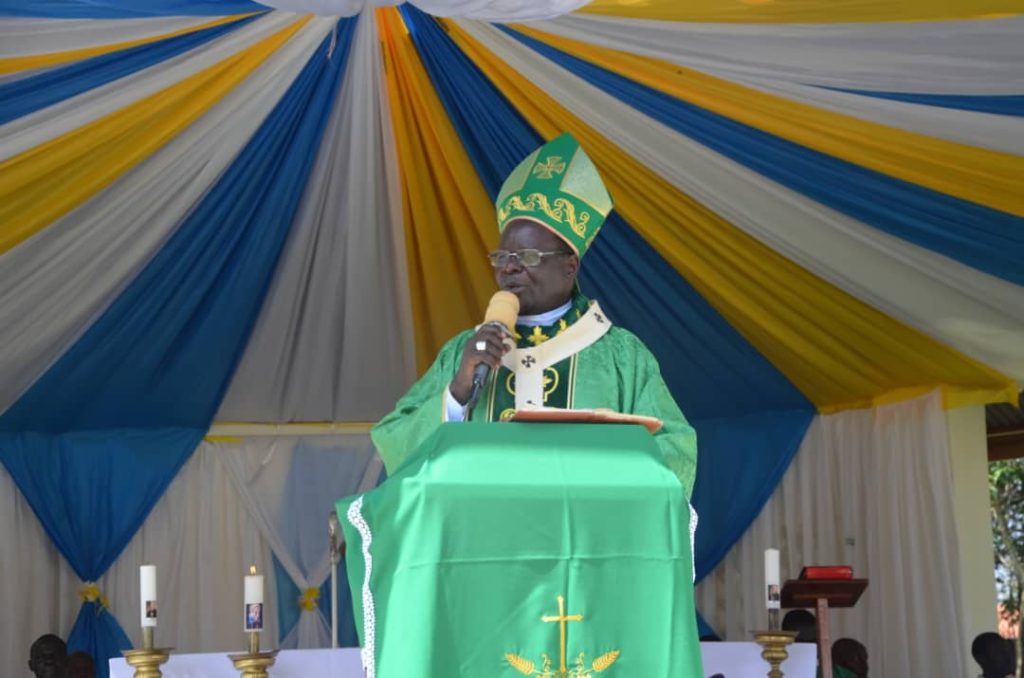
“Today is a special day. I would say it is special for two reasons. First, I would like to share with you that today, 12 July, marks my second year since I was installed as Archbishop of Gulu. I remember that day when our church was filled with believers, friends, and well-wishers, all gathered to thank God for the gift of vocation.
Today, I would like, together with you, to renew my gratitude to God and thank Him for calling me to be the shepherd of this Archdiocese.
Together, let us pray. Pray for the Archdiocese, and also pray for me. As we commemorate this anniversary of my installation, I would like us to recall the two main symbols that accompanied the celebration.
You may still remember something we call the Pallium. The Pallium is a piece of wool, somewhat like a scarf that we wrap around our necks when it is cold to protect us from bad weather. Many of you may see it as merely a design, but I want to remind you that it is a sign of pastoral care and communion with the Holy Father, the Pope.
Every year, on 29 June, the Pope presents the Pallium to newly appointed archbishops in Rome, at the Vatican. In 2024, on 29 June, we went to Rome to receive this Pallium, this special symbol of pastoral care that the Pope gives to archbishops, uniting them with him in the ministry and mission of the Church.
The white wool comes from sheep and is carefully prepared by the Cistercian monks. Every year, they raise sheep, shear their wool, and make the Pallium. The Pallium is not easy to find. Sometimes I ask myself, ‘What will I do if it gets dirty?’ because you cannot buy it anywhere.
This Pallium is made specifically for archbishops. It is given to them because they are collaborators of the Pope in the special mission of the Church.
Wearing the white wool reminds us that all authority comes from the Lamb of God. The Pope wears the Pallium, and archbishops also wear it, reminding us that the sheep from whose wool the Pallium is made represents the Lamb of God, from whom the authority for our ministry comes.
We know that the lamb is a symbol of peace. In the Bible, the sheep is an animal that listens, an animal that cooperates with the plan of God. The sheep represents Jesus Christ, the Lamb of God, who was sacrificed for the salvation of the world.
Sheep and goats are also presented in the image of the Last Judgment in the Gospel of Matthew. On the last day, people will be gathered just as sheep and goats are gathered, and they will be separated. The sheep will be placed on the right, while the goats will be placed on the left.
The goats represent the stubbornness of humankind—those who are stubborn, who do not listen, and who do not receive the Good News. The sheep, on the other hand, are those who obey and follow the Good News.
So, dear children of God, perhaps this is one way of looking at our lives.
Are you a sheep or a goat? Do you want to be a sheep or a goat? What do you want to be—a sheep or a goat?”
Source: Selected excerpts from the homily of Grace Raphael P’Mony Wokorac, Archbishop of Gulu, delivered during the celebration of Missionary Childhood Day and the second Anniversary of his Installation as Archbishop of Gulu on 12th July, 2026.