

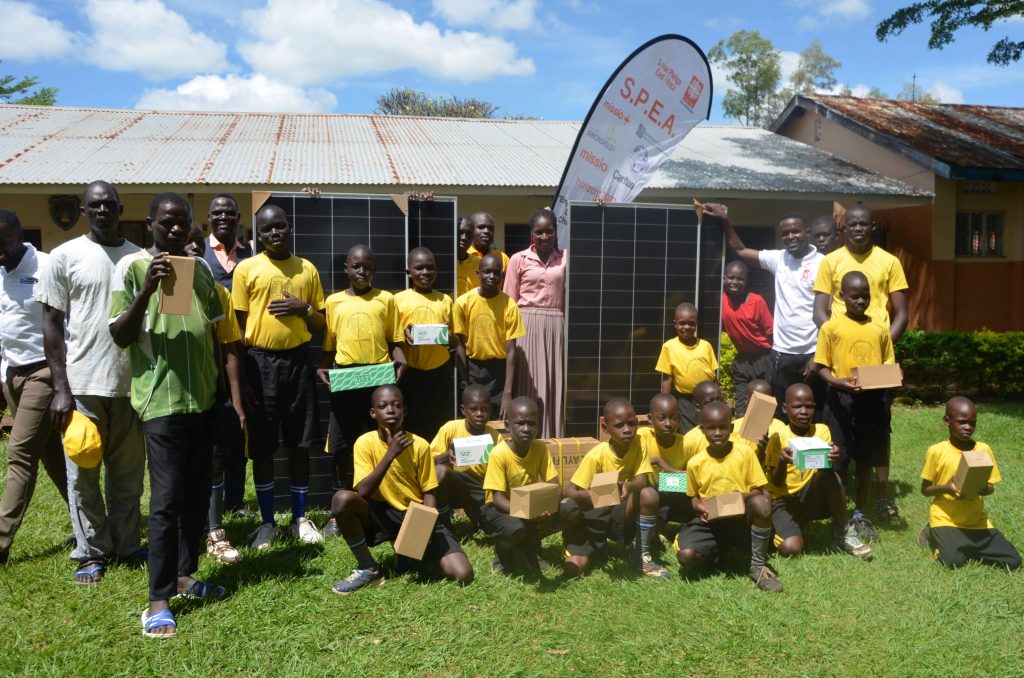
Solar Pledge East Africa (SPEA) POWERING SCHOOLS IN THE ARCHDIOCESE OF GULU (Northern Uganda)
Project Background, Objectives & Phase One Supported Institutions
IMPLEMENTING PARTNERS Caritas Gulu Archdiocese & HORIZONT3000 | PILOT TIMELINE June 2024 – May 2027 | TARGET DIOCESES Archdiocese of Gulu (Uganda) & Diocese of Lodwar (Kenya) |
- The Rationale of SPEA
Solar Pledge East Africa (SPEA) is a pilot project implemented by Caritas Gulu Archdiocese in partnership with HORIZONT3000 and supporting partners. Running from June 2024 to May 2027, the initiative spans the Archdiocese of Gulu in Uganda and the Diocese of Lodwar in Kenya.
Renewable energy is central to achieving the vision of Laudato Si’ and the United Nations Sustainable Development Goals (SDGs), particularly SDG 7, which calls for access to affordable, reliable, sustainable, and modern energy for all. Despite its critical importance, many solar and renewable energy initiatives face long-term sustainability challenges due to complex technical, financial, and institutional factors.
To address these challenges, SPEA equips the Archdiocese of Gulu with the tools, frameworks, and capacity needed to integrate renewable energy into its daily operations and long-term strategic planning. Project activities focus on building human and institutional capacity—including developing diocesan renewable energy strategies—with particular emphasis on advancing integral human development across the education and health sectors.
- Project Objectives
- Transnational Support Platform: Establish a transnational support platform to assist the Dioceses of Gulu and Lodwar in mainstreaming and implementing renewable energy solutions.
- Institutional & Operational Capacity: Strengthen the capacity of partner dioceses to integrate renewable and solar energy priorities into their operational plans, budgets, and daily activities.
- Access to Clean Energy Services: Improve access to affordable, reliable, and modern energy services across diocesan institutions.
- Institutions Supported in Phase One (5 December 2025 – 28 February 2026)
During Phase One of the solar installation rollout, SPEA supported 20 educational and healthcare institutions across northern Uganda:
# | Institution Name | District / Location | Sector |
1 | St. Theresa Primary School | Otumpili | Education |
2 | St. Theresa of Calcutta Secondary School | Omoro District | Education |
3 | Odek Primary School | Omoro District | Education |
4 | Atanga Girls Secondary School | Pader District | Education |
5 | Padibe Girls Secondary School | Lamwo District | Education |
6 | Sts. Peter and Paul Health Centre III | Lamwo District | Healthcare |
7 | Padi Opei Secondary School | Lamwo District | Education |
8 | Omiya Anyima / Lupur Primary School | Lamwo District | Education |
9 | Adilang Secondary School | Agago District | Education |
10 | St. Joseph Bobi–Minakulu Health Centre III | Omoro / Oyam Border | Healthcare |
11 | Bishop Angelo Negri Primary School | Gulu City | Education |
12 | St. Joseph’s Primary School | Agago District | Education |
13 | Fr. Rafael Debari Nursery and Primary School | Gulu | Education |
14 | Mary Mother of God Nursery and Primary School | Amuru District | Education |
15 | Bishop Angelo Negri College | Gulu | Education |
16 | Msgr. Antonio Vignato Secondary School | Kitgum District | Education |
17 | Pabbo Comprehensive Secondary School | Amuru District | Education |
18 | Giulio Pastore Primary School | Kitgum District | Education |
19 | St. Francis Health Centre Anaka | Nwoya District | Healthcare |
20 | David Fergerlee Medical Centre | Agago District | Healthcare |
- Purpose of Solar PV Support to Selected Institutions
The primary purpose of installing solar photovoltaic (PV) systems in selected schools and health centres is to expand access to reliable, affordable, and sustainable energy—thereby strengthening the delivery of essential education and healthcare services.
Specific Objectives of the Installations:
- Improve Access to Reliable Electricity: Provide institutions with a dependable power supply to support daily operations, particularly in areas with limited or unreliable grid connectivity.
- Enhance the Quality of Education: Create a better learning environment in schools through adequate lighting in classrooms, laboratories, libraries, and administrative offices, while powering teaching and learning equipment.
- Improve Healthcare Service Delivery: Equip health centres with reliable electricity for essential medical services, nighttime emergency lighting, refrigeration of vaccines and medicines, and operation of basic medical equipment.
- Reduce Operational Costs: Minimize expenditure on costly alternative energy sources—such as diesel generators and fuel—allowing institutions to redirect savings toward their core educational and healthcare mandates.
- Promote Environmental Sustainability: Reduce dependence on fossil fuels and lower greenhouse gas emissions through the adoption of clean, renewable solar energy.
- Strengthen Institutional Energy Sustainability: Build local capacity to operate, maintain, and sustainably manage solar energy systems through user training, technical support, and sound energy management practices.
- Improve Institutional Productivity and Efficiency: Extend productive working and study hours, improve staff working conditions, and foster an environment that supports effective service delivery.
- Expected Outcome & Long-Term Development Impact
Expected Overall Outcome: Improved quality, accessibility, and efficiency of education and healthcare services in supported institutions through increased access to reliable, affordable, and sustainable solar energy.
Long-Term Development Impact: Stronger educational outcomes, resilient healthcare services, and enhanced community well-being driven by sustainable access to clean energy.
Key Positioning Note SPEA should not be viewed merely as a solar hardware installation project. Its broader purpose is to harness renewable energy as a catalyst for stronger education, improved healthcare delivery, long-term institutional sustainability, and holistic community development. |